The solvent is dead, long live the solvent…
How is Solvent Printing Doing in the Market?
In many history books, we read the phrase "The King is dead, long live the King"—the old king dies, and the new king is welcomed and becomes the greatest king.
The history and evolution of printing technology and processes could be compared to this premise. In the solvent printing business, this has been happening. Older ink technologies that were smelly and of poor quality, but seen as wonderful in their time, are being replaced by a new generation of inks that are bright, odorless, and long-lasting.
Is Solvent the right technology for the printing industry at this time?
Há muitas novas tecnologias de tinta que chegaram ao mercado nos últimos anos. As principais são Latex (tintas à base de resina) e tecnologia de tinta UV. O Latex está no mercado há cerca de 5-6 anos e tornou-se numa tinta de nicho de mercado para muitos segmentos de impressão. A Mimaki é a única empresa para além da HP que tem desenvolvido Latex. Vemos o mercado da especialidade como uma oportunidade significativa onde o uso de latex é uma vantagem para todos na cadeia de fornecimento. A utilização em interior de latex tem uma vantagem suprema porque Latex é um não-COV e tinta HAPS. Isto faz esta tinta ideal para decoração de interiores, tais como papel de parede, sinalização de interiores e os mercados de impressão de prova. Este último segmento é algo que foi recentemente desenvolvido pela Mimaki pela adição de tintas látex laranja e verde ao portfólio de modo que a gama de cores é maior do que offset. A mais recente geração de tinta de látex faz com que seja possível ter uma solução premium para provas comerciais, especificamente sobre muitos substratos não revestidos. O Latex também oferece impressão de transparências devido à disponibilidade de tintas brancas látex. É possível usar transparências com um efeito de película aderente numa impressora Latex. A impressora também pode usar a impressão cor / branco / cor para fazer uma imagem perfeita em contraluz para impressão dia e noite com esta tecnologia.
So, if Latex is the solution, why stick with solvent printing?
Antes de responder a esta, vamos olhar para outra tecnologia de tinta, tintas de cura UV. Estas tintas estão aparecendo em muitos mercados e para muitas aplicações diferentes. No início as tintas UV foram curadas por grandes lâmpadas UV quentes que endureciam as tintas alterando os monómeros para polímeros. Isto resultou em grandes tintas para substratos rígidos mas não úteis para substratos rolo-a-rolo devido ao facto de as tintas UV não serem muito flexíveis. Isso mudou nos últimos anos. As tintas de hoje são muito mais flexíveis e pode até mesmo ser usada para decoração de viaturas dando cerca de 200% de estiramento. Agora é possível imprimir todos os suportes rolo-a-rolo com tinta UV e destituir Latex e Solvente todos juntos.
So why solvent printing?
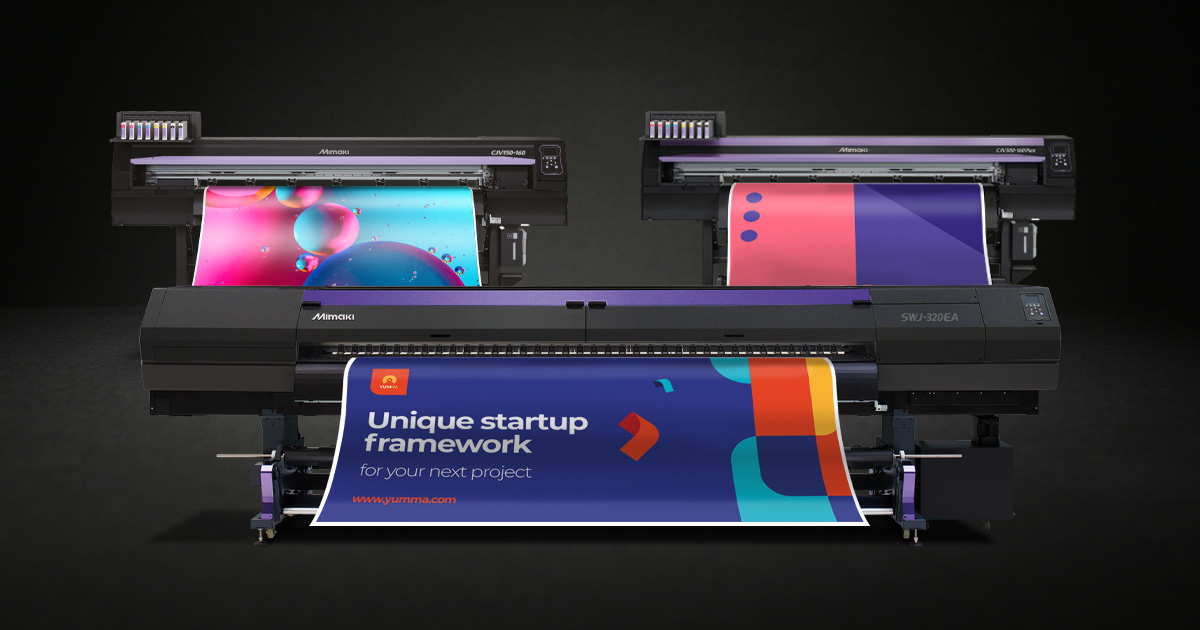
Well, first of all, it is a choice because UV LED printers can have a more expensive production method. The reason many users choose printing is still the advantage it offers when printing on rigid printing substrates. There are, of course, some hybrid solutions on the market, but these are not very effective. Roll-to-roll printing on an expensive flatbed printer is not only inefficient, but I believe you should use the printer for the purpose it is made for. You can always buy a smaller roll-to-roll printer that is faster and better for the price of the roll option on a flatbed printer. At Mimaki, we don't have a roll option for this very reason. Why pay €20,000 for something that will give you, say, 20 m²/h when you can get a printer that can do 100 m²/h for the same price?
Thus, UV printing has taken a share of the solvent and latex markets, but it may still not be the right solution for many markets and applications. It is great for glass, wood, metals, cardboard, foam, and types of substrates that do not fit in a roll-to-roll printer. One of the other problems with UV is that adhesion is not always as good on all substrates. Surface tension is very important for perfect adhesion, so you cannot print on all substrates—although adding a primer to the substrate can solve this problem. Flame, plasma, and corona treatment all help with ink adhesion, but it is still a form of trial and error printing. Lately, we have seen new technologies that could replace solvent printing, but for some reason, this has not happened yet. There must be a reason, right? Yes, there is—but I will get to that later.
So, is there more? You bet!
Mimaki has a new technology called SUV or Solvent UV Hybrid Ink. This new technology combines the best of both worlds. The solvent ink side provides excellent adhesion to vinyl, while the UV ink side achieves the gloss and color finish you want. This type of UV ink component is also flexible, so you can really work with it on a roll. The other advantage is that you don't have to wait before you start working with it. You can laminate without waiting. The advantage with this ink technology is that there is enough time for the pigment particles within the ink to fall and settle on the substrate, giving it a very flat surface and thus great scratch resistance and also the best reflection of the widest range of colors you can think of. The results are impressive. As the ink has a large UV pigment component, its resistance to weather and light is also extremely good. Three months outdoors on a vinyl substrate is possible without any concerns. It is therefore perfect for short-term outdoor jobs without the need for lamination. With this element, you can save a large part of the production cost.
Does it seem like a winning technology? Mimaki believes so—SUV is the way to go!
Although this is a great technology, there is still a large market for solvent inks. More affordable production costs, the availability of various substrates, and high printing speeds still make Solvent the king of large format printing.
Today, solvent-based inkjet printers can print with very high quality standards on canvas at speeds of up to 100 m²/h. It is possible to print perfectly on transparencies with white solvent ink—silver inks also give metallic effects that are not available in other technologies. Solvent solutions work and are much cleaner than is generally known. Even with the new REACH laws and environmental considerations, we still have great technology at our disposal.
Just think—what other technology allows you to print and cut on a single machine?
What other technology can you use to decorate a car, create a retail poster, or community signage just by changing the media?
What printing technology allows you to print at 100 m²/h for less than €20,000?
No technologies have yet been able to replace solvent technology on all these fronts.
So long live the KING—Solvent is still the KING of Large Format.
Mike Horsten – Director Geral de Marketing EMEA Mimaki na Mimaki Europe